How to Choose a Ceramic Bonded Rubber Hose?
Choosing the right Ceramic Bonded Rubber Hose requires more than comparing prices or outer diameters. It requires a clear understanding of the material being transported, operating conditions, and maintenance environment. A hose carrying abrasive slurry faces different demands from one handling dry powder, chemicals, or hot air.
Start with the real application.
Observe the connection points, pressure changes, bending areas, and nearby heat sources. Even a short hose may experience vibration, impact, and repeated flexing. These details often determine service life more accurately than a product brochure. Ceramic lining can improve abrasion resistance, while the rubber body provides flexibility and shock absorption.
A reliable selection process checks hose size, working pressure, temperature range, ceramic thickness, rubber compound, and reinforcement structure. It also reviews the ceramic bonding method, because weak adhesion may cause early failure under vibration. Experienced suppliers should explain test procedures, quality controls, and suitable installation practices. Their advice should match measurable operating data, not vague promises.
Consider the failure cost.
A damaged hose can release material, interrupt production, and create difficult cleanup work. Clamps, bends, and unsupported weight deserve careful attention during inspection. Correct routing may extend service life as much as choosing a stronger hose. This point is sometimes overlooked.
No selection is flawless. Conditions can change after installation, and laboratory results cannot represent every site. For that reason, keep records of pressure, temperature, wear patterns, and replacement intervals. Compare those observations with the manufacturer’s recommendations. Practical evidence should guide the final decision. The best Ceramic Bonded Rubber Hose is not simply the toughest option. It is the one that fits the application, remains dependable, and can be monitored honestly.
Understanding Ceramic Bonded Rubber Hose Construction
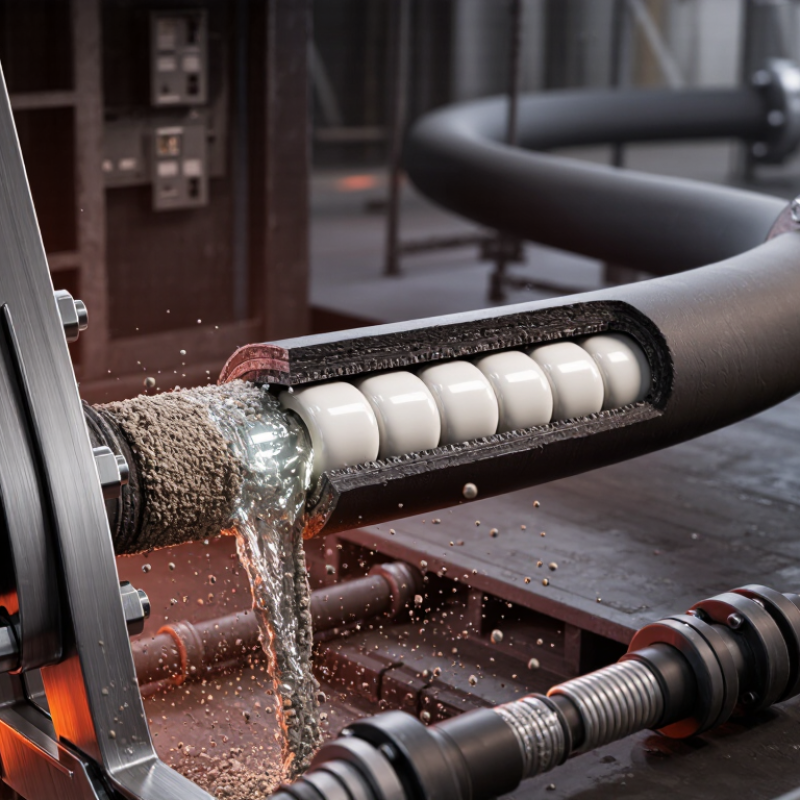
Choosing a ceramic bonded rubber hose starts with its internal construction, not its outer appearance. The hose usually combines a flexible rubber tube, bonding layer, ceramic tiles or cylinders, and a protective outer cover. The rubber absorbs vibration and bending. The ceramic resists sliding particles, impact, and cutting wear. This balance matters in mining, steel, cement, and slurry transport. The World Steel Association reported 1.89 billion tonnes of crude steel production in 2023, showing the scale of abrasive industrial handling. Yet, production volume alone cannot determine hose design.
Ceramic shape and placement control performance. Dense alumina pieces suit high-wear zones, while smaller segments can follow tighter bends. The bonding layer must remain elastic during pressure changes and temperature cycling. Poor surface preparation may cause early separation, even when the ceramic looks flawless. USGS Mineral Commodity Summaries 2024 reported global bauxite production above 380 million metric tons in 2023. That figure reflects a large mineral-processing environment, but it does not guarantee every Ceramic Hose is suitable. I have seen specifications focus too much on hardness. That is an incomplete decision.
Tips: Check particle size, flow speed, operating temperature, minimum bend radius, and pressure together. Ask for abrasion testing under conditions close to your application. Inspect tile edges and bonding areas, not only the rubber cover. A thinner lining may bend better. It may also wear faster. When selecting a hose, leave room for uncertainty. Field conditions are rarely as clean as laboratory tests.
How to Choose a Ceramic Bonded Rubber Hose?
Understanding the hose construction helps match the lining thickness and rubber protection to the working conditions. The chart shows representative nominal layer thicknesses for three common design priorities.
A thicker ceramic lining generally improves resistance to abrasive solids, while thicker rubber layers improve impact absorption and flexibility. Actual dimensions should be confirmed against pressure, temperature, particle size, bend radius, and installation requirements.
Identifying the Hose’s Working Conditions and Conveyed Materials
Choosing a ceramic bonded rubber hose starts with its working conditions, not its diameter. Record operating pressure, temperature, flow velocity, vacuum exposure, bending radius, and installation movement. A hose carrying dense slurry may suffer rapid wear at elbows and reducers. Mining volumes show the scale of this challenge. The USGS Mineral Commodity Summaries 2024 reports approximately 2.5 billion metric tons of iron ore mined globally in 2023. That material often travels with water, creating severe impact and sliding abrasion.
Identify the conveyed material in detail. Particle size, hardness, density, concentration, pH, and shape all influence hose life. Sharp quartz behaves differently from rounded coal particles. The Energy Institute Statistical Review of World Energy 2024 records more than 8.7 billion tonnes of coal production in 2023, highlighting the demanding conditions in bulk handling systems. Ceramic lining can resist intense abrasion, while rubber absorbs vibration and tolerates movement. However, ceramic is not automatically suitable for high temperatures, sudden impact, or aggressive chemicals. A neat specification sheet can still mislead.
Ask for measured data, not assumptions. Test slurry concentration and temperature during peak production. Check whether the hose will start empty, run full, or experience pressure surges. I have seen selections fail because engineers used average conditions. That was a costly oversight. Review inspection records, liner thickness, joint design, and minimum bend radius before approval. Allow a safety margin, but avoid excessive stiffness that makes installation unsafe.
Matching Pressure, Temperature, Size, and Flow Requirements
How to Choose a Ceramic Bonded Rubber Hose?
A ceramic bonded rubber hose must match the system’s pressure, temperature, size, and flow.
Pressure is not a guess. ISO 18752:2023 classifies hydraulic hoses by working pressure, including classes near 5, 10, 20, and 40 MPa. Select a hose with a rated working pressure above the pump’s maximum pressure, including surges. A practical safety margin matters. I would still verify surge data from the pump manufacturer.
Temperature changes rubber performance and ceramic bonding strength.
Check continuous and peak temperatures separately. Hot slurry can soften elastomers, while sudden cooling may create contraction stress. ASTM D2000 provides a useful framework for comparing rubber compounds by temperature and resistance properties. Do not rely only on the hose’s nominal temperature label.
Internal diameter controls velocity and pressure loss.
A smaller bore increases velocity, friction, and wear. A larger bore may reduce velocity and allow solids to settle. Many slurry systems target approximately 3–5 m/s, but particle size and density can change that range. USGS Mineral Commodity Summaries 2024 reported about 960 million metric tons of U.S. construction sand and gravel production in 2023. That scale shows why abrasion planning cannot be casual.
Tips:
Measure the actual flow rate, solids concentration, and particle size. Check flange dimensions before ordering. Inspect bend radius on site. Ceramic is not magic. Incorrect velocity can still destroy a premium lining. Leave room for pressure spikes, thermal cycling, and installation errors.
Evaluating Flexibility, Reinforcement, Wear Resistance, and Installation
When selecting a ceramic bonded rubber hose, start with the movement it must survive. Measure the bend radius, travel distance, and connection angle carefully. Do not treat flexibility as a soft outer cover. The hose must bend without cracking the ceramic lining or stressing its reinforcement. In field work, I have seen a hose fail after repeated tight loops. The lining looked intact, but the wire layers had fatigued. That detail changed how I inspect hose routing. Leave room for movement.
Reinforcement should match the working pressure, vacuum conditions, and mechanical load. Steel wire supports demanding service, while textile layers may suit lighter applications. Check the pressure rating at the actual operating temperature, not only at room temperature. Ceramic provides strong protection against abrasive slurry, but it is not indestructible. Large stones, sudden impact, or poor bonding can create local damage. I once focused too heavily on hardness and underestimated impact energy. That was a useful correction. Consider particle size, flow speed, temperature, and chemical exposure together.
Installation often determines service life. Align both flanges before tightening the bolts. Never twist the hose to correct an offset. Use proper supports, suitable gaskets, and an even tightening pattern. Keep the hose away from sharp edges and excessive heat. After installation, inspect for bulges, leaks, unusual vibration, and restricted movement. A pressure test is sensible, but it cannot reveal every hidden ceramic fracture. Recheck the hose after several operating cycles. Small routing problems become expensive wear patterns.
Checking Quality Standards, Service Life, and Supplier Support
Choosing a Ceramic Bonded Rubber Hose?
A reliable hose begins with verifiable quality standards, not a polished product sheet. Ask for material certificates, pressure-test records, and batch traceability. The ceramic lining should show consistent tile placement, secure bonding, and no visible gaps. Request abrasion and hydrostatic test results for the intended service conditions. Standards matter, but their scope matters more. A certificate may cover rubber quality, not the complete hose assembly.
Service life depends on more than ceramic hardness. Slurry concentration, particle size, temperature, pressure, and flow speed can change wear rates significantly. Correct installation is equally important. Respect the minimum bend radius. Prevent twisting near flanges. Support long horizontal runs to avoid sagging. Inspect high-wear elbows and reducers regularly. Small cracks deserve attention. I have seen hoses fail early because operators tracked operating hours but ignored sudden pressure changes. That approach needs improvement.
Supplier support becomes critical after delivery. A capable supplier should provide installation drawings, storage guidance, inspection intervals, and replacement advice. They should also explain how performance data was collected. Ask whether they can review photos, examine failed sections, and recommend a revised design. Fast replies are useful, but technically specific replies are better. Keep written records of pressure, temperature, and wear observations. No supplier gets every prediction right. Honest discussion of uncertainty is a stronger sign of reliability than confident promises.
| Evaluation Dimension | What to Check | Relevant Standard or Verification Method | Practical Acceptance Guidance | Decision Priority |
|---|---|---|---|---|
| Application Compatibility | Material being conveyed, particle size, concentration, temperature, pressure, vacuum, bending movement, and installation orientation. | Review the hose technical datasheet and compare it with the actual operating conditions. | The selected hose should be rated for the maximum continuous temperature and pressure, including start-up, shutdown, surges, and vacuum conditions. | Critical |
| Ceramic Lining Design | Ceramic tile or cylinder arrangement, lining thickness, joint layout, bonding method, and coverage of high-wear areas. | Inspect drawings, cross-sections, sample sections, and product quality records. | The lining should provide continuous protection through bends and elbows without exposed rubber gaps at the intended wear zone. | Critical |
| Abrasion Resistance | Resistance to sliding and impact wear from sand, ore, ash, cement, slurry, or other abrasive media. | Request abrasion-test results using a recognized method such as ISO 4649 or ASTM D5963, where applicable. | Test conditions should resemble the actual conveyed material. A test result without the abrasive type, load, speed, and temperature is not sufficient for comparison. | Critical |
| Bond Strength | Adhesion between the ceramic elements, rubber matrix, and hose reinforcement; resistance to tile loosening during flexing. | Review destructive bond testing, peel or pull-off testing, and production inspection records. | Failure should not occur at the ceramic-rubber interface under the specified operating and flexing conditions. Test method and minimum value must be documented. | Critical |
| Pressure Rating | Working pressure, proof pressure, burst pressure, pressure pulsation, and pressure spikes. | Verify compliance with the applicable hose construction and pressure-test requirements, such as ISO 1307 where relevant. | The maximum working pressure should exceed the highest measured system pressure with an appropriate engineering safety margin. Do not use burst pressure as the operating limit. | Critical |
| Temperature Resistance | Continuous temperature, short-term peak temperature, thermal cycling, and temperature at the hose wall rather than only at the process line. | Compare the rubber compound rating with the media temperature and verify thermal-aging or heat-resistance data. | The operating temperature should remain within the compound manufacturer's continuous rating. Repeated excursions above the rating can accelerate hardening, cracking, and bond failure. | Critical |
| Chemical Compatibility | Compatibility of the rubber, ceramic, adhesive, tube, and cover with acids, alkalis, oils, solvents, salts, and process additives. | Use fluid-resistance data according to ISO 1817 or an equivalent recognized test method. | The test fluid, concentration, temperature, exposure time, volume change, hardness change, and visual condition should be reported. | Critical |
| Flexibility and Minimum Bend Radius | Minimum dynamic and static bend radius, repeated movement, torsion, and whether the ceramic lining can follow the hose curvature. | Check the manufacturer's bend-radius specification and perform a movement trial using the actual routing. | The installed bend radius should not be below the stated minimum. Avoid twisting, sharp kinks, unsupported weight, and bending directly behind rigid couplings. | Critical |
| Dimensional Accuracy | Inside diameter, outside diameter, wall thickness, length, flange dimensions, and concentricity. | Measure finished dimensions against the approved drawing and applicable hose dimensional requirements, including ISO 1307 where applicable. | Dimensions should remain within the agreed drawing tolerances and must allow correct coupling fit, flow area, and installation clearance. | Important |
| Reinforcement Quality | Cord or wire type, reinforcement layers, cover integrity, splice quality, and resistance to pressure and external damage. | Review construction drawings, production inspection records, and pressure or impulse testing where applicable. | Reinforcement must match the pressure, vacuum, movement, and external-load requirements. No exposed reinforcement, blisters, cuts, or irregular splices should be accepted. | Critical |
| Leak and Pressure Testing | Leak tightness, proof-pressure performance, end-fitting integrity, and pressure retention. | Require a documented hydrostatic or pneumatic test procedure appropriate to the hose design and service risk. | Each finished hose should have traceable test results when required by the application. The test pressure, duration, medium, and acceptance criteria must be recorded. | Critical |
| Visual and Ceramic Inspection | Cracks, chips, voids, exposed rubber, uneven joints, delamination, blisters, cover damage, and flange-area defects. | Perform 100% visual inspection and, for critical service, use suitable non-destructive or sectioning checks. | Ceramic pieces should be firmly seated, with no loose sections or open paths that could allow abrasive media to reach the rubber substrate. | Critical |
| Estimated Service Life | Expected wear rate, replacement interval, failure history, operating duty cycle, and inspection frequency. | Use application-specific field data, wear monitoring, and documented reference installations without relying only on a generic lifetime claim. | A defensible estimate should state the medium, flow velocity, temperature, pressure, duty cycle, hose geometry, and inspection basis. Service life is application-dependent and cannot be guaranteed by hose material alone. | Critical |
| Weight and Handling | Finished hose weight, lifting points, support spacing, coupling weight, and operator handling requirements. | Compare the certified mass and installation instructions with the available supports and lifting equipment. | The support system should carry the hose when full and should prevent excessive load on couplings, flanges, and moving equipment. | Important |
| End Connections | Flange or coupling type, pressure class, sealing face, bolt pattern, liner continuity, and galvanic or chemical compatibility. | Verify against the approved piping drawing and applicable connection standard. | Connections should align without forcing the hose. The ceramic-lined flow path should not create a sharp step, exposed edge, or obstruction at the joint. | Critical |
| Traceability | Hose identification, batch number, production date, dimensions, pressure rating, material designation, and test record. | Check the marking, certificate, inspection report, and packing list. | Every hose should be traceable to its production batch and inspection results, especially when used in high-pressure, hazardous, or difficult-to-access locations. | Important |
| Supplier Technical Support | Engineering review, sizing assistance, installation instructions, routing guidance, troubleshooting, and replacement recommendations. | Evaluate the quality and completeness of the technical submittal before purchase. | The supplier should provide a clear datasheet, approved drawing, installation limits, inspection procedure, and a named technical contact. | Critical |
| Warranty and Claims Process | Warranty duration, exclusions, evidence requirements, response time, and corrective-action procedure. | Review the written warranty and service terms rather than relying on verbal assurances. | The warranty should define coverage for manufacturing defects, ceramic delamination, leakage, and premature failure, with clear reporting and investigation steps. | Important |
| Spare Parts and Lead Time | Availability of replacement hoses, matching couplings, emergency production capability, and delivery time. | Request standard and expedited lead times, minimum order quantities, and recommended spare quantities. | For critical lines, maintain at least one correctly specified spare or establish a documented replacement plan based on risk and historical consumption. | Important |
| Installation and Maintenance | Storage conditions, cleaning method, support arrangement, inspection points, wear indicators, and replacement criteria. | Follow the supplier's installation manual and establish a site inspection checklist. | The inspection plan should include visual checks, leakage checks, cover condition, coupling condition, bend-radius compliance, and measured wall or lining wear where feasible. | Critical |
| Total Cost of Ownership | Purchase price, installation, support hardware, downtime risk, inspection cost, replacement frequency, and disposal. | Compare lifecycle cost rather than purchase price alone. | A higher initial cost may be justified when the hose provides verifiable wear life, reduced change-out frequency, lower downtime, and reliable technical support. | Important |